

Devotional Planning Ecosystem: Element I - The Capture System
Capture your ideas, stay connected to inspiration, and close the tabs in your brain so you can design your calendar and life from what matters most to you. Post 2 of a 7 post series.
Moon Update: 🌑 New Moon in Taurus 5/16 3:01p.m. CT. This is the reset. The dark sky asking you to begin again… slowly and on purpose. Taurus wants intentions rooted in the body, not the mind. What do you actually want to feel? Plant that.
Seasonal Update: Strawberries are here. Stone fruit is weeks away. Zucchini is just beginning to show up and will soon be everywhere (you’ve been warned). Herbs are lush before the heat pushes them to bolt: basil, cilantro, mint at their most generous. This is peak farmers market season before summer gets serious. A good week to eat simply and slowly. Let the food be the ritual.
Devotional Planning
If you haven’t read my introduction to this series, I recommend starting there:

The Devotional Planning Ecosystem is a set of containers and rituals that support you in living your life with intention, connected to the divine. The ecosystem is designed to work for anyone — entrepreneurs, stay-at-home moms, business professionals, creatives, etc.
I created Devotional Planning to support myself and others in:
Living life from a conscious connection to the divine
Practicing discernment in how we spend our time and energy — intentionally planning vs. reacting to life
Balancing the feminine creativity and inspiration that comes through our creative channels with the masculine structure of a planning system so ideas and desires can come to fruition in reality
This ecosystem was originally designed for Coven, my seasonal sacred accountability community for women. It was so supportive for the women in the collective that I decided to give it away to my Substack community as well.
I’m releasing the different elements of the ecosystem one by one, so you have time to practice each piece individually. Here is the release schedule:
✔︎ May 1st: Introduction + Journaling Practice & Workbook
→Today: The Capture System + (for paid subscribers) a checklist to get your Capture System set up and an instructional video using my system as an example.
⃞ May 27th: The Daily Ritual + (for paid subscribers) a printable worksheet for your daily rituals and an instructional video.
⃞ June 4th: The Weekly Ritual + (for paid subscribers) a printable checklist and worksheet for your weekly ritual, guidance for practicing, and an instructional video.
⃞ June 14th: The Lunar Rituals + (for paid subscribers) printable guides for lunar rituals and an instructional video.
⃞ June 21st: The Seasonal Ritual + (for paid subscribers) a seasonal meditation, journaling prompts, a worksheet to set your seasonal intentions, and an instructional video.
⃞ December 21st: The Annual Ritual + (for everyone) a live workshop to complete the ritual together with a meditation, journaling prompts, and a worksheet.
In today’s installment of the Devotional Planning Ecosystem, I’ll be taking you through The Capture System — how it works, how to set it up, and how to use it.
For paid subscribers: if you’d rather watch a video than read through this post, I’ve included an Instructional Video + a Setup Checklist below to get your Capture System up and running.
Human Design In The Ecosystem
The entire Devotional Planning Ecosystem was created with Human Design in mind. I wanted a system that worked with my energy, not against it. If you’re unfamiliar with Human Design, you can get your free chart and read a little bit more about it here - scroll below the chart form to read about the different elements of Human Design before requesting your chart. (Head’s up: the birth date entry puts the day before month, so make sure you do it correctly to get an accurate chart. April 10 = 10/04.)
I love Human Design because it is a great tool to better understand myself and how my energy works, it gives me access to my intuition, and provides a framework for decision making that is specific to me. All-in-all, it stopped me from making myself wrong for operating the way I’m designed to operate in life. It felt very validating, and now I work with my design, not against it.
You’ll see callouts like this for each element of the system to help you understand the nuances of how your design type can best relate to each one.
Element I: The Capture System


Before an idea gets planned, organized, or acted on, it has to live somewhere. We need to capture it.
Most of us end up with several sticky notes, pads of paper, digital notes, open tabs, and emails that all comprise a general “to do list.” No wonder it feels like chaos, and we feel overwhelmed by everything to do.
As I was building my own business and had less structure in my days, I noticed how squirrely my brain was. I would jump from task to task, reacting to whatever came in: an email, a text message, an idea sparked by something on social media, etc.
Although it kept me very busy, I finished my days feeling really unfulfilled, like I hadn’t gotten anything done. As a creative entrepreneur, there’s never a shortage of good ideas… so I knew I needed a system and practice to help me be more discerning and intentional. I had to confront that I wasn’t actually going to act on all of my ideas.
So, I created The Capture System to support me in housing my ideas somewhere so I didn’t lose them, while intentionally planning which ones I wanted to act on using my Human Design authority, instead of starting them in the moment and never getting anything done.
The Capture System is built around three dedicated containers, each with a distinct job. Nothing competes with anything else. Everything has a right home. When something lands in the correct container, it stops creating noise: it gets held, without pressure, until I am ready to move on it.
Here is a brief overview of the three containers I recommend you start with:
The Capture Note: One note, where everything lands first. You can make it voice-to-text friendly if that makes it easier for you. No need to sort it in the moment, at least when you start out. Anytime you think of something to do, you add it to your list. (Regular and Advanced options included in the full description below.)
The Inspiration Library: A well of content to draw from for projects, interests, or entertainment. This can include articles, books, podcasts, videos, shows, quotes... if someone recommends something to you, you can add it here. If you come across an article you’d like to read but you don’t have the time right now, put the link in the library.
The Vision & Idea Board: A living space for ideas as they come to you, so you don’t lose them. This can include projects for around the house, content ideas for your business, a craft for your kiddos, or a retreat you want to create in the future.
A note on making this yours:
Devotional Planning is a living framework, not a fixed structure, and your life may ask for more than what is outlined here.
A Dream Journal for what arrives in sleep. An Evidence container for the universe’s fingerprints. A Prayer container for what you are asking for and surrendering. A Grief container for what needs to be held without being acted on. A container for the creative experiments that don’t belong anywhere else.
There is no wrong answer. The right system is the one that holds everything your life actually contains.
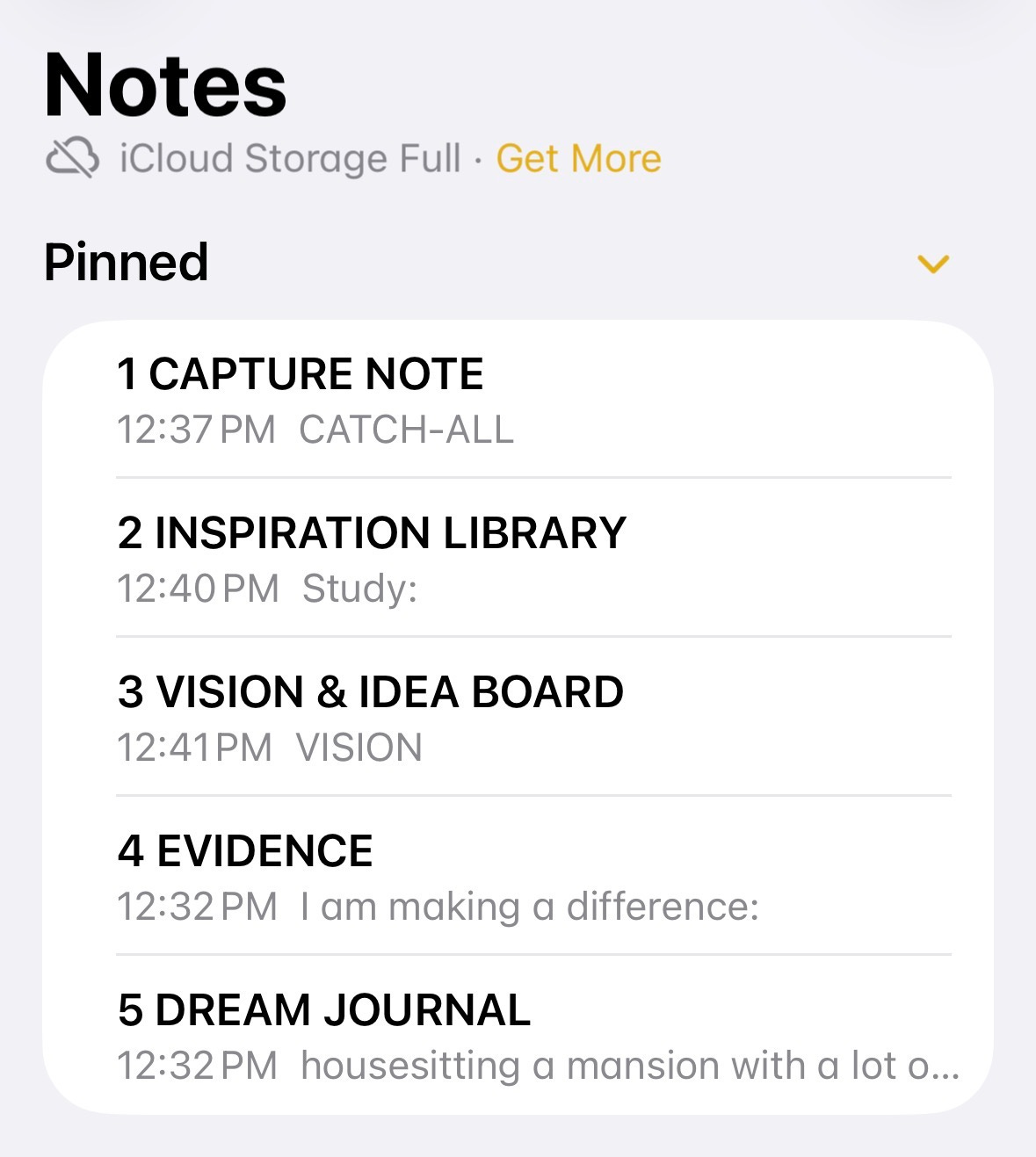
Start with the three I suggest, and then add what your life asks for. Below is what mine looks like right now, using Apple Notes, which I like because I always have my phone with me, and I can add to it with or without wifi.
The Capture Note
One single note, digital or analog, where everything you need to capture lands first. Tasks, ideas, recommendations, random thoughts, things you do not want to forget. No organization, no judgment, no sorting in the moment. The only rule is that everything goes here first and there is only one of these. Nothing else competes with it.
The Capture Note is not a to-do list. It is a landing pad. Its job is to get things out of your head and into a safe place so your nervous system and brain can release them. The sorting happens later (during your Daily Altar or Sacred Planning session, which I’ll explain in full detail in subsequent posts.) In the moment of capture, your only job is to put it down.
The single most common reason this container stops working: a woman starts keeping more than one. A note on her phone and a notebook on her desk and a voice memo app and a sticky note on the fridge. When capture is scattered, nothing feels safe to put down because nothing feels reliably held. Keep one note.
Within your Capture Note, I recommend having three distinct sections, with space between each one for lists:
Catch-All:
Next Week:
Further Out:
Here is what mine looks like right now:
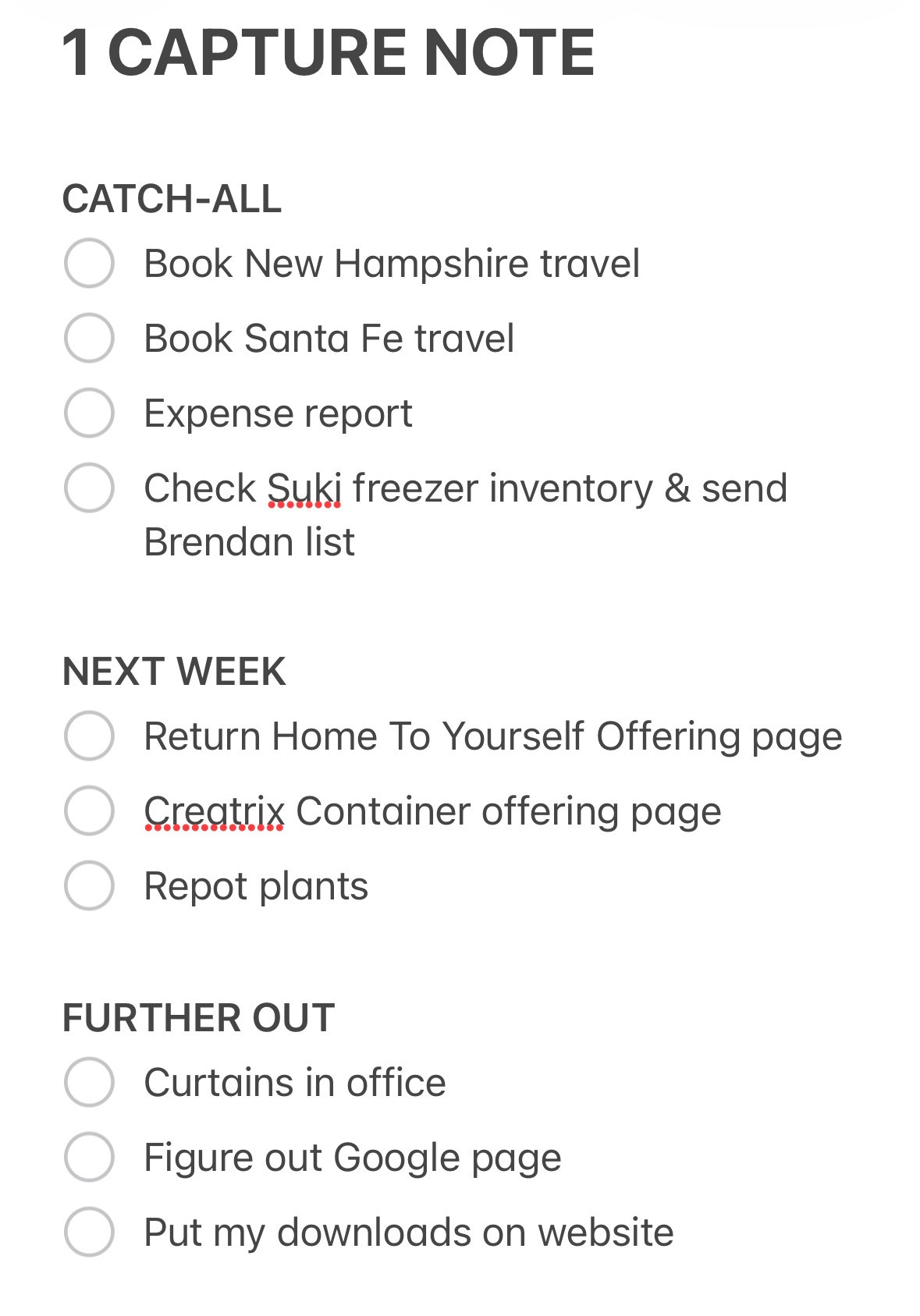
When you drop something into your note, put it in the Catch-All section. During The Daily Altar or Sacred Planning rituals (coming soon), you’ll move things to Next Week or Further Out depending on their urgency.
Note: Before you receive and start practicing the Daily Altar and Sacred Planning rituals, you can set a daily reminder in your phone to check your Capture Note and add anything urgent to your day’s to-do list or calendar.
Advanced Option
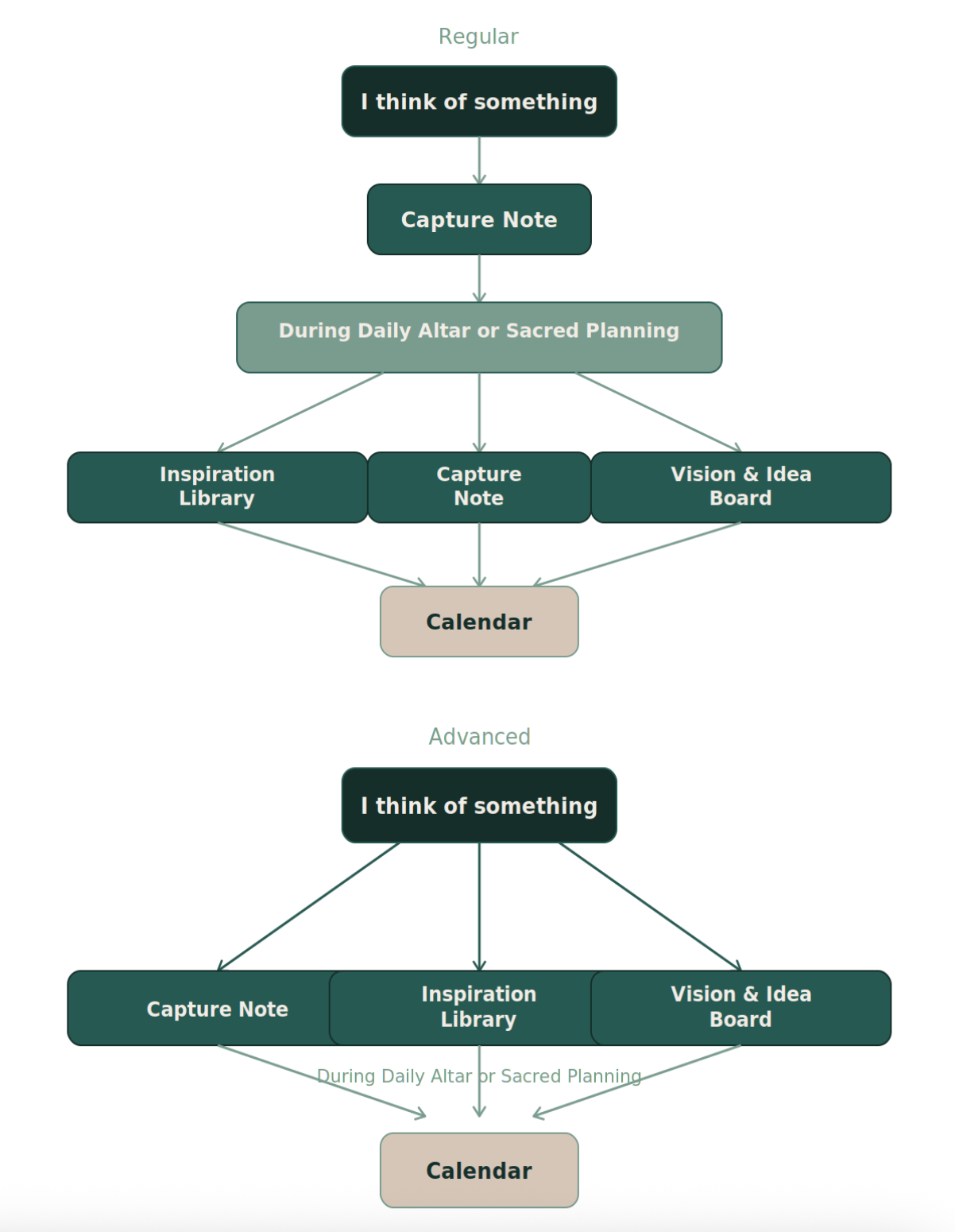
Once you get the hang of this system, or if you’d prefer to sort as you capture, you can start adding items directly into one of the three containers as you think of them. For example, if you think of a piece of content to write, you can put it directly into your Vision & Idea Board. However, I recommend starting with the Capture Note as a catch-all for everything, then sorting things into the secondary containers during your rituals.
Here are the regular and advanced option flows. Do what works best for your brain.
Human Design & The Capture Note
If you are a Generator or Manifesting Generator, your Capture Note will fill quickly. You move fast, respond to everything, and generate ideas constantly. Voice-to-text is your friend, the friction of typing is enough to make you skip the capture entirely. Let it be fast and messy. The mess is correct.
If you are a Projector, your Capture Note will have less volume but more depth. You may find it useful to keep a small section for ideas and invitations you’ve received but aren’t ready to act on yet: things that arrived before the right moment. For a Projector, this isn’t procrastination, it’s leveraging your design to discern the correct timing.
If you are a Manifestor, your Capture Note needs to be frictionless above everything else. Your inspiration moves through you like lightning and it will not wait for a system that requires more than one tap to open. The simpler the tool, the more you will actually use it. Complexity is the enemy of capture for your type.
If you are a Reflector, your Capture Note can be gentle and spacious. There is no pressure to capture everything, only what genuinely wants to be held. You are not built for the relentless throughput of a Generator. Let your note reflect your actual relationship with ideas: selective, receptive, unhurried.
The Inspiration Library
A separate, dedicated home for everything that feeds, expands, and inspires you. Books you want to read. Podcasts someone recommended. Articles saved to return to. Teachers you want to explore. Courses that caught your attention. Any content that belongs to your growth rather than your output.
Don’t think of this as a to-do list. Nothing in the Inspiration Library is urgent. There are no deadlines, no items that carry consequence if they go untouched this week. This container accumulates over time and you dip into it when you have space to consume, not space to do. The distinction matters. Consumption is its own form of tending. It is how the inner life gets fed so the outer work has something to draw from.
The most common mistake with this container: letting it become another source of pressure. A library that makes you feel behind is not functioning as a library. It is functioning as a to-do list with better aesthetics. If you open your Inspiration Library and feel guilt rather than appetite, either the container has become too large to feel navigable, or you are approaching it with the wrong energy. Return to the question: what am I genuinely hungry for right now?
Human Design & The Inspiration Library:
If you are a Generator or Manifesting Generator, your Library will likely be rich and full. The same energy that fills your Capture Note will fill this one too. The practice here is not to consume everything at once, it is to let the Library be an abundance you dip into rather than a backlog you work through. One or two things per week, chosen by genuine appetite, is enough.
If you are a Projector, your Inspiration Library is your power source. Rest and consumption are genuinely productive for you, not indulgent. When you read, listen, and absorb, you are doing your actual work. Let this container be as full and rich as it wants to be.
If you are a Manifestor, your Library may be sparse, and that is correct. You generate more than you consume. The ideas move through you from somewhere else so you are less a student of others’ thinking and more a channel for your own. If your Library stays mostly empty, that is not a failure of curiosity. It is your design.
If you are a Reflector, your relationship with this container is subtle and worth paying attention to. You absorb the energy of everything and everyone around you, which means you can find yourself drawn to content that reflects your environment rather than your own genuine appetite. Before you add something to your Library, pause for a moment: is this mine, or am I absorbing it from someone else’s enthusiasm? Your Library should reflect what you are genuinely drawn to, not what the people around you are consuming.
Some women find they want to split this container into a separate home for spiritual and devotional reading, distinct from professional development or creative inspiration. If the qualities of those two streams feel different to you, trust that. Give them separate homes. Again, make this container yours. There is no right way to do this.
The Vision & Idea Board
A living document where big dreams, future visions, seeds of possibility, and germinating ideas live before they are ready to be acted on. Business ideas you haven’t developed yet. Life visions you’re moving toward. Projects you want to build someday. Directions you feel pulled in but haven’t committed to. Things you want to call in. Things you want to become.
This is not a goal-setting document or a to-do list. It is a field of possibility you tend rather than manage. Personal and professional visions live here together, because for a woman building a life and a calling simultaneously, they are not separate, and a system that treats them as separate will always feel like it is missing something.
Nothing in this container is urgent. It is where things live until they are ready to move. Some things will live here for a season, and some for years, and some will quietly disappear when they are no longer true, and all of that works.
For women whose work includes creating content such as writing, podcasting, teaching, coaching, or building an audience, I recommend a dedicated section within the Vision & Idea Board to hold future content specifically. Post concepts you haven’t written yet. Series you want to build. Things you want to say someday. Creative directions waiting their turn. This section keeps content ideas from bleeding into your broader vision space, and it means you will never sit down to create and feel like you have nothing. The ideas are already waiting.
Human Design & The Inspiration Library
If you are a Generator or Manifesting Generator, your Vision & Idea Board will fill quickly, possibly faster than any other container. The practice here is not to act on everything that lands. Let the Board be the place where ideas prove themselves over time. What is still alive in three months is worth moving. What has gone quiet was either ahead of its time or simply not yours.
If you are a Projector, your Board may hold things for a very long time before the right invitation arrives to move them. A vision that has been sitting for a year is not stagnant, it is waiting for correct timing. Trust the wait. The Board is doing its job when it holds things patiently.
If you are a Manifestor, your Vision & Idea Board is where your initiations are born. You may feel a quality of urgency here that others don’t: a sense that these things need to move now. Sometimes that urgency is correct. Sometimes it is the initiation impulse running ahead of the moment. Let ideas sit for at least one full week before you act. If they are still pulling at you after seven days, they are probably ready.
If you are a Reflector, your Board needs the gift of time more than any other type. A full lunar cycle (one complete month) before anything here feels truly clear. What looks like a brilliant idea on the new moon may feel entirely different by the full moon. This is not indecision. This is your design asking for the full rotation before you commit. Honor it.
Getting Started: Setting Up Your Capture System
Choose the container you want to use to set up your Capture System. I recommend using your phone’s default notes app, since you’ll always have it with you and it isn’t reliant on wifi to work (like Notion or other cloud-based notes apps are.)
Before you have the full Devotional Planning Ecosystem set-up, you’ll be missing the Daily and Weekly rituals that prompt you to tend to your Capture System. Until you receive those posts, I recommend you review your Capture Note each morning before starting your day, so you don’t miss any urgent items.
Below, for paid subscribers, I’ve included a downloadable checklist to set up your Capture System plus an instructional video that covers everything in this post and takes you through the checklist step-by-step.
The Capture System Checklist & Video are available for paid subscribers only.
Why join as a paid subscriber?
Every lunar cycle (about 30 days), in addition to three personal essays, an interview with a fellow Creatrix, and access to the She Who Makes chat, paid subscribers receive:
Four downloadable resources per lunar cycle: released on the 🌑 New Moon, 🌓 First Quarter, 🌕 Full Moon, and 🌗 Last Quarter. My downloads include workbooks, journaling prompts, printable guides, and meditations designed to move what you’re reading about off the page and into your actual life.
Access to my growing vault of practical resources.
Discounted pricing on workshops and community events.
I’m building a world where you are divine. Where you have access to God. Where the part of you that is God is not a metaphor — it’s the truth you’re here to live into.
The workbooks, meditations, and rituals behind my paid subscription are the same ones I build for my 1:1 clients. They’re designed to meet you at the edge of what you know and pull you into the territory that’s been waiting for you on the other side.
The free essays are the map. The downloads are the door.
$8 a month. The door is here when you’re ready to walk through it.
Set Up Checklist & Instructional Video
To get started on using The Capture System, here is a video diving into the details as well as a step-by-step checklist to get yourself set up.
Keep reading with a 7-day free trial
Subscribe to She Who Makes to keep reading this post and get 7 days of free access to the full post archives.